
Kundalini
Kundalini is a Sanskrit word meaning either "coiled up" or "coiling like a snake." There are a number of other translations of the term usually emphasizing a more serpent nature to the word - e.g. 'serpent power'.
Kundalini
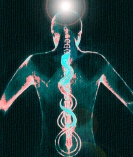 The caduceus symbol of coiling
snakes is thought to be an ancient symbolic representation of Kundalini
physiology.The concept of Kundalini comes from yogic philosophy of ancient India and
refers to the mothering intelligence behind yogic awakening and spiritual
maturation. It might be regarded by yogis as a sort of deity, hence the
occasional capitalization of the term.
The caduceus symbol of coiling
snakes is thought to be an ancient symbolic representation of Kundalini
physiology.The concept of Kundalini comes from yogic philosophy of ancient India and
refers to the mothering intelligence behind yogic awakening and spiritual
maturation. It might be regarded by yogis as a sort of deity, hence the
occasional capitalization of the term.
Within a western frame of understanding it is often associated with the
practice of contemplative or religious practices that might induce an
altered state of consciousness, either brought about spontaneously, through
a type of yoga, through psychedelic drugs, or through a near-death
experience.
According to the yogic tradition Kundalini is curled up in the back part of
the root chakra in three and one-half turns around the sacrum. Yogic
phenomenology states that kundalini awakening is associated with the
appearance of bio-energetic phenomena that are said to be experienced
somatically by the yogi.
This appearance is also referred to as "pranic awakening". Prana is
interpreted as the vital, life-sustaining force in the body. Uplifted, or
intensified life-energy is called pranotthana and is supposed to originate
from an apparent reservoir of subtle bio-energy at the base of the spine.
This energy is also interpreted as a vibrational phenomena that initiates a
period, or a process of vibrational spiritual development.
The source text for the concept of kundalini is the "Hatha Yoga Pradipika"
written by Swami Svatmarama (English translation, 1992) somewhere between
the twelfth and fifteenth centuries. Any examination of the topic should
include this work. The pradipika is one of the later developments in yoga
sacred texts. Hatha Yoga is strictly speaking a forcing technique which has
as its primary aim the forcing of the arising of kundalini.
The main emphasis is a difficult regime of breathing techniques meant to
increase the store of "prana" in the body. The well known physical postures
are only meant to be an aid to maintain peak physical fitness, so as to
support the real work of the breathing practices. All of this has, according
to tradition, to be accompanied by prolonged and unbroken meditation
practice (for which the main text is the "Yoga Sutras of Patanjali"). The
text adds that great good fortune is another requirement, i.e.luck, for the
procedure to succeed. However, these techniques are not without dangers.
The Interpretation of Kundalini
Two early western
interpretations of Kundalini were supplied by C.W. Leadbeater (1847-1934),
of the Theosophical Society, and the analytical psychologist Carl Jung
(18751961).
Jung's seminar on Kundalini yoga, presented to the Psychological Club in
Zurich in 1932, has been widely regarded as a milestone in the psychological
understanding of Eastern thought and of the symbolic transformations of
inner peace.
Kundalini yoga presented Jung with a model for the developmental phases of
higher consciousness, and he interpreted its symbols in terms of the process
of individuation. (Princeton University Press Book description to C. G Jung
- "The Psychology of Kundalini Yoga", 1999).
A few western translators interpret the energetic phenomena as a form of
psychic or paranormal energy although the western parapsychological
understanding of psychic energy, separated from its cultural-hermeneutic
matrix, is probably not the same as the yogic understanding. Yogic
philosophy understands this concept as a maturing energy that expresses the
individual's soteriological longings. Viewed in a mythological context it is
sometimes believed to be an aspect of Shakti, the goddess and consort of
Shiva.
Kundalini might be said to be a popular concept, since it is widely quoted
among various disciplines of yoga and New Age beliefs. However, the recent
popularization of the term within new religious movements has - according to
some scholars of religion - not contributed to promote a mature
understanding of the concept (Sovatsky, 1998). As with many eastern
contemplative concepts there exist considerable difficulties, and possible
semantic confusion, connected to the way these concepts are adapted to a
western context.
This has led to somewhat different interpretations and applications of the
concept of Kundalini within the spiritual and contemplative culture in the
west. On the one hand there are the New Age popularizations, and on the
other hand there is the traditional lineage of Kundalini Yoga understood
from its cultural background and interpreted within the academic fields of
Religious Studies, Pastoral Theology and Transpersonal/Humanistic
psychology.
With the tools of these academic traditions it is possible to give different
interpretations to the concept of Kundalini; such as physiological
interpretations, psychological interpretations, clinical interpretations,
religious interpretations, mythological interpretations and spiritual
interpretations.
Kundalini Yoga
Kundalini Yoga is a meditative
discipline - or a system of meditative techniques and movements - within the
yogic tradition that focuses on psycho-spiritual growth and the body's
potential for maturation. The practice of Kundalini Yoga consists of a
number bodily postures, expressive movements and utterances,
characterological cultivations, breathing patterns, and degrees of
concentration.
The movements and the body-work should not - according to some scholars of
religion - be considered mere stretching exercises. The concept of
life-energy - pranotthana - is central to the practice and understanding of
Kundalini Yoga. It also gives special consideration to the role of the spine
and the endocrine system in the understanding of yogic awakening. Recently,
there has been a growing interest within the medical community to study the
physiological effects of meditation, and some of these studies have applied
the discipline of Kundalini Yoga to their clinical settings.
Kundalini in the World's Religions
Kundalini is mainly associated
with Hinduism. However, Kundalini as a spiritual experience is thought to
have parallels in many of the mystical and Gnostic traditions of the world's
great religions.
Many factors point to the universality of the phenomenon. The early
Christians might have referred to the concept as 'pneuma', and there are
some recent parallels in contemporary Christian Charismatic 'Holy Ghost'
phenomena. Religious studies also note parallels in Quakerism, Shakerism,
Judaic Shuckling (torso-rocking prayer), the swaying zikr and whirling
dervish of Islam, the quiverings of the Eastern Orthodox hesychast, the
flowing movements of tai chi, the ecstatic shamanic dance, the ntum trance
dance of the Bushman, Tibetan Buddhist tummo heat as practiced by Milarepa,
and the Indically-derived Andalusian flamenco (Sovatsky, 1998). Kundalini
practice is centerfold in Japan's Aum Shinrikyo group and Kundalini-yoga is
also one of the stages the practitioner is able to achieve.
Kundalini Rising
According to yogic terminology
the force of Kundalini is supposed to be raised through meditative exercises
and activated within the concept of a subtle body, a body of energy and
finer substance. This process has been explained in detail by Motoyama
(1981) and by Sharp (2005). Motoyama bases the bulk of the Kundalini raising
practices listed in the book on the notable Swami Satyananda Saraswati, as
well as on personal experience in helping people in various stages of
Kundalini awakening. Sharp provides a kundalini meditation called The Great
Invocation along with detailed guidance on controlling and managing the
energy flow and subsequent manifestation.
Kundalini-experiences are often understood in terms of the Hindu chakra
system, the understanding of psycho-spiritual energy centers along the spine
(Scotton, 1996). According to Hindu tradition the Kundalini raises from the
root-chakra up through the spinal channel, called sushumna, and it is
believed to activate each chakra it goes through.
Each chakra is said to contain special characteristics (Scotton, 1996). In
raising Kundalini, spiritual powers (siddhis) are also believed to arise,
but many spiritual traditions see these phenomena as obstacles on the path,
and encourages their students not to get hung up with them (Kason, 2000).
Although the opening of higher chakras are believed to mark advanced
spiritual unfoldment, it is important not to measure spiritual growth solely
by the opening of higher potentials. According to this view chakras might be
under- or overdeveloped, and lower chakras are thought to be just as
important as higher.
Spiritual literature also describes instances where Kundalini is said to be
initiated. Initiation of kundalini activity is usually considered to take
place by a practice called shaktipat. This is a form of 'laying on of hands'
where physical contact to the body or the forehead of the subject by the
guru, or initiator, is supposed to cause an experience of Kundalini that
later may persist or grow with continuing practice, or fade away if practice
is stopped. Scotton (1996) mentions that kundalini-symptomatology is
associated with such practices as shaktipat. He also gives a case-example of
such a practice from an American meditation retreat.
According to much contemporary spiritual literature, and the field of
Transpersonal Psychology, it is not considered wise to engage in any of
these practices without the guidance of a credible teacher or without
thorough psychological preparation and education in yoga. Any form of
intense contemplative or spiritual practice without the support of a
cultural context, or without the support of thorough psychological
preparation, is usually considered to be unfortunate, and in some cases even
dangerous. Traditional teachers of kundalini meditation also warn neophytes
of the potential dangers of experimenting with kundalini Yoga techniques.
These warnings should not be underestimated. A growing body of clinical and
psychological literature notes the growing occurrence of meditation-related
problems in Western contemplative life. Among these we find the Kundalini
Syndrome (which is presented more closely later in this article) and
different forms of "wind illness" described in the Tibetan tradition.