First Council of Nicaea
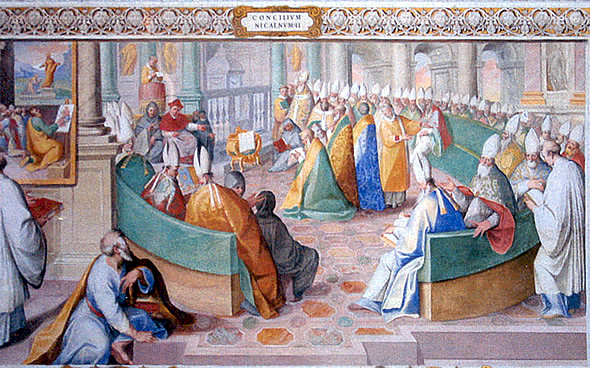
The First Council of Nicaea was a council of Christian bishops convened in Nicaea in Bithynia (present-day İznik in Turkey) by the Roman Emperor Constantine I in A.D. 325. The Council was the first effort to attain consensus in the church through an assembly representing all of Christendom.
Controversy
In June, 325 A.D., the Council of Nicaea opened and continued for two months, with Constantine attending. The bishops modified an existing creed to fit their purposes. The creed, with some changes made at a later fourth century council, is still given today in many churches. The Nicene Creed, as it came to be called, takes elaborate care by repeating several redundancies to identify the Son with the Father rather than with the creation:
"We believe in one God, the Father Almighty, maker of all things visible and invisible; and in one Lord Jesus Christ, the Son of God, the only-begotten of his Father, of the substance of the Father, God of God, Light of Light, very God of very God, begotten, not made, being of one substance with the Father. By whom all things were made ... Who ... was incarnate and was made human ..."
Only two bishops, along with Arius, refused to sign the creed.
Constantine banished them from the empire, while the other bishops went
on to celebrate their unity in a great feast at the imperial palace.
The creed is much more than an affirmation of Jesus' divinity. It is
also an affirmation of our separation from God and Christ. It takes
great pains to describe Jesus as God in order to deny that he is part of
God's creation. He is "begotten, not made," therefore totally separate
from us, the created beings. As scholar George Leonard Prestige writes,
the Nicene Creed's description of Jesus tells us "that the Son of God
bears no resemblance to the ... creatures."
The description of Jesus as the only Son of God is carried forward in
the Apostles' Creed, which is used in many Protestant churches today. It
reads: "I believe in God, the Father Almighty ... I believe in Jesus
Christ, his only Son, our Lord." But even that language - calling Jesus
God's only Son - denies that we can ever attain the sonship that Jesus
did.
Christians may be interested to know that many scholars analyzing the
Bible now believe that Jesus never claimed to be the only Son of God.
This was a later development based on a misinterpretation of the gospel
of John.
There is further evidence to suggest that Jesus believed all people
could achieve the goal of becoming Sons of God. But the churches, by
retaining these creeds, remain in bondage to Constantine and his three
hundred bishops.
Some of the bishops who attended the council were uncomfortable with the
council's definition of the Son and thought they might have gone too
far. But the emperor, in a letter sent to the bishops who were not in
attendance at Nicaea, required that they accept "this truly divine
injunction."
Constantine said that since the council's decision had been "determined
in the holy assemblies of the bishops," the Church officials must regard
it as "indicative of the divine will."
The Roman god Constantine had spoken. Clearly, he had concluded that the
orthodox position was more conducive to a strong and unified Church than
the Arian position and that it therefore must be upheld.
Constantine also took the opportunity to inaugurate the first systematic
government persecution of dissident Christians. He issued an edict
against "heretics," calling them "haters and enemies of truth and life,
in league with destruction."
Even though he had begun his reign with an edict of religious
toleration, he now forbade the heretics (mostly Arians) to assemble in
any public or private place, including private homes, and ordered that
they be deprived of "every gathering point for [their] superstitious
meetings," including "all the houses of prayer." These were to be given
to the orthodox Church.
The heretical teachers were forced to flee, and many of their students
were coerced back into the orthodox fold. The emperor also ordered a
search for their books, which were to be confiscated and destroyed.
Hiding the works of Arius carried a severe penalty - the death sentence.
Nicaea, nevertheless, marked the beginning of the end of the concepts of
both preexistence, reincarnation, and salvation through union with God
in Christian doctrine. It took another two hundred years for the ideas
to be expunged.
But Constantine had given the Church the tools with which to do it when
he molded Christianity in his own image and made Jesus the only Son of
God. From now on, the Church would become representative of a capricious
and autocratic God - a God who was not unlike Constantine and other
Roman emperors.
Tertullian, a stanch anti-Origenian and a father of the Church, had this
to say about those who believed in reincarnation and not the
resurrection of the dead: "What a panorama of spectacle on that day [the
Resurrection]! What sight should I turn to first to laugh and applaud?
... Wise philosophers, blushing before their students as they burn
together, the followers to whom they taught that the world is no concern
of God's, whom they assured that either they had no souls at all or that
what souls they had would never return to their former bodies? These are
things of greater delight, I believe, than a circus, both kinds of
theater, and any stadium." Tertullian was a great influence in having
so-called "heretics" put to death.